

The Premise
Old Seagrove is one of 30A’s most distinctive enclaves of 50x100 lots, a few larger near the beach with really good views and many larger ones that will not have a view further away. It is a blend of original cottages and high-design new builds that define today’s market. As the leading re-developer in this area, we’ve had a front-row seat to how the real economics play out versus what sellers tend to believe and cling to. We are the #1 team in Old Seagrove from Seaside to Sea Highlands and have been now of more than 7 years.
The Baseline Sale
A sale of a 5,100 sq. ft. home closed at $5,169,000, fully furnished, with an above-average Gulf view and premium finishes is our starting point. The home was contracted before completion, which speaks to the demand for well-designed, move-in-ready finer residential homes. By the way for the skeptics in the area, out of 14 homes we helped develop in Old Seagrove ending in September 2025 (now with more to come) 9 sold to non-rental owners. We are very proud of that. We are hoping in our business to bring in families that want to be here.
The all-in build cost was $2,594,000 plus $169,000 in furnishings, for a total investment of $2,763,000. Factoring in 5% agency commission and 0.7% Walton County stamp tax, we can work backward to understand the underlying economics. Economics gets behind by a touchdown or two but at the final horn it is always the winner. We can talk about that anytime. As a trained economist I do think I have some insight here. We track data too. By the way that all in build costs is a ready to furnish home. That includes the pool, landscaping, a generator in this case, fencing and all the things that some builders add on as additional costs. So if you did the math and got to $508 per sq ft you need to subtract about $164,000 to get to other builder comparisons. $476 with the builder fee included.
The Framework
We are not looking at this through the lens of leverage, financing, or speculative emotion. The market only deals with the economics of activity not the ego of it. I am sure like the next person I too would like to say I got a 78% return building a home because of the use of leverage. But the home is only going to yield the nominal dollar return it will yield. The market does not pay you for your financing choices and never has. In fact, we have noted over good times and not so good times the investor that struggles the most is the undisciplined leveraged investor. While they may make more return, the cash investor is the tortoise. He wins the race.
This is a cash-based economic reality check — the difference between being an investor and being a cowboy.
Leverage distorts understanding. Cash reveals the reality of economics. We’re talking about what a property is worth not what someone can temporarily afford to overpay for with cheap credit or leverage a build to limit deployed capital to goose ROI. We are not against leverage. We use it ourselves but as a former private equity manager, I and my then clients had a certain awareness of discipline and risk most do not possess.
The Cold Hard Math
For this illustration the sale price is fixed at $5,169,000. After 5% agency commission and 0.7% stamp tax, the net sale proceeds are:
Net Sale Proceeds = $5,169,000 × (1 − 0.05 − 0.007) = $4,874,367
Build + Contractor fee (important later) + furnishings are fixed at $2,763,000. For a two‑year project, the residual lot value (what an investor can pay for the dirt) that still achieves the required annualized return is:
Residual Lot Value = Net Sale Proceeds / (1 + r)^2 − Build & Furnish Cost (sorry for the data wonky text!)
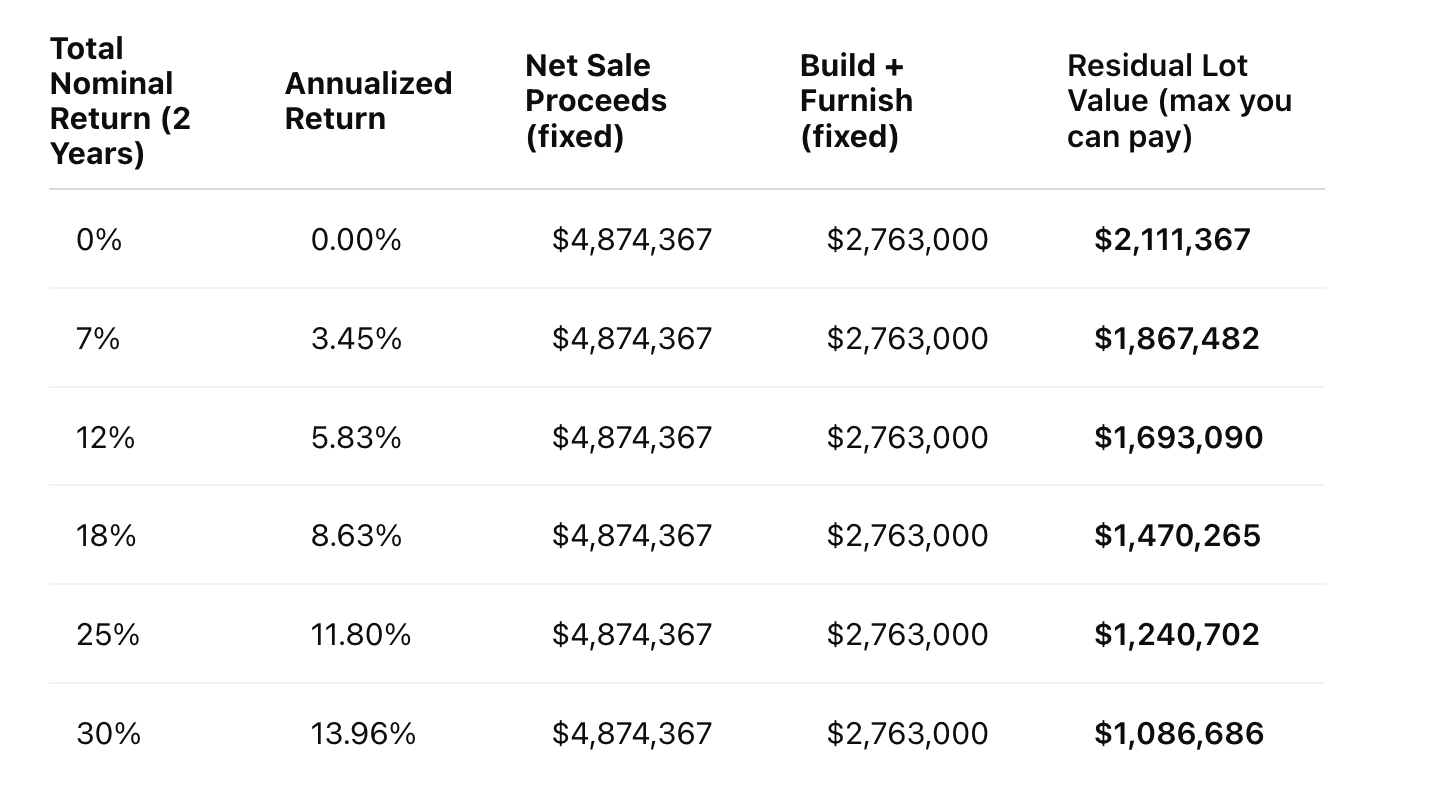
Who the Hell Would Do 0%, 7%, 12%, 18%, 25%, or 30%?
0% Return: The sentimental homeowner. The “I just want to live here” crowd. This is lifestyle-driven, not economically rational. Have we had buyers in this category. Yes but only in Seaside, Florida.
7% Return: The cautious renovator or second-home buyer telling themselves they’ll “break even” after enjoyment. They are occupiers with upside, not true investors. This is a growing category of our own business but accounts for less than 5 of our 22 homes we worked ending in September of 2025. Of the 21 we have coming now we do not know the stats yes but we do know 2 of those homes are non rental so they will be sold to true second home owners.
12% Return: The disciplined small developer. Knows their numbers, values time and capital, and accepts moderate risk for solid reward. This will also tend to be someone that uses leverage to get a higher ROI on capital. This is the watch out zone.
18% Return: The professional builder-operator. Understands execution risk, carries overhead, and expects market cycles. This is sustainable for professional redevelopers like us. This is me and Gayle and one of our primary builder clients. We have the cash to sustain multiple builds and with the occasional sale before completion our actual rates of return both annually and nominally rise substantially.
25% Return: The opportunist or contrarian who buys mis priced land, times cycles perfectly, and takes calculated—but rare—shots. These projects exist, but they’re few and far between. A friend of mine who is also a real estate professional is a master at this model. Still if we find land mis priced any one of our investors purchases it right away. This is rare air and takes fear from land owners.
30% Return: The rare market outlier — exceptional timing, unique lot, or unusual value creation. Usually luck, inside knowledge, or the early bird catching the next trend. Not many of these. This only occurs when there is a pandemic and prices of finish produce soars.
The Cowboy Capitalist and the Mirage of Leverage
For the leverage illustration, we’re now using the 25% nominal return case as the benchmark that one implied a land basis of $1,240,702, the figure that most closely aligns with a motivated Capital investor builder who’s confident in their ability to execute efficiently. But this is not Just the builder. This person is paying a contractor fee embedded in our numbers.
That gives us a realistic total project cost:
Build + Furnish: $2,763,000
Land: $1,240,702
Total Cost (including land): $4,003,702
With net sale proceeds fixed at $4,874,367, the nominal profit (2-year) becomes:
Profit = $4,874,367 − $4,003,702 = $870,665
This calculates now to a 22% return after all costs. 25% is our hurdle rate.
Leverage doesn’t change dollars of profit; it changes the equity required, which changes the annualized return on equity. Below we apply financing as a percent of total cost (including land) and compute the resulting annualized return on cash invested over two years (no timing or interest modeled here deliberately simplified to show the optical effect only . It is a fair bit more subtle when you consider the timing of cash flow and the returns are actually modestly higher in all cases. As interest rates change these numbers change.
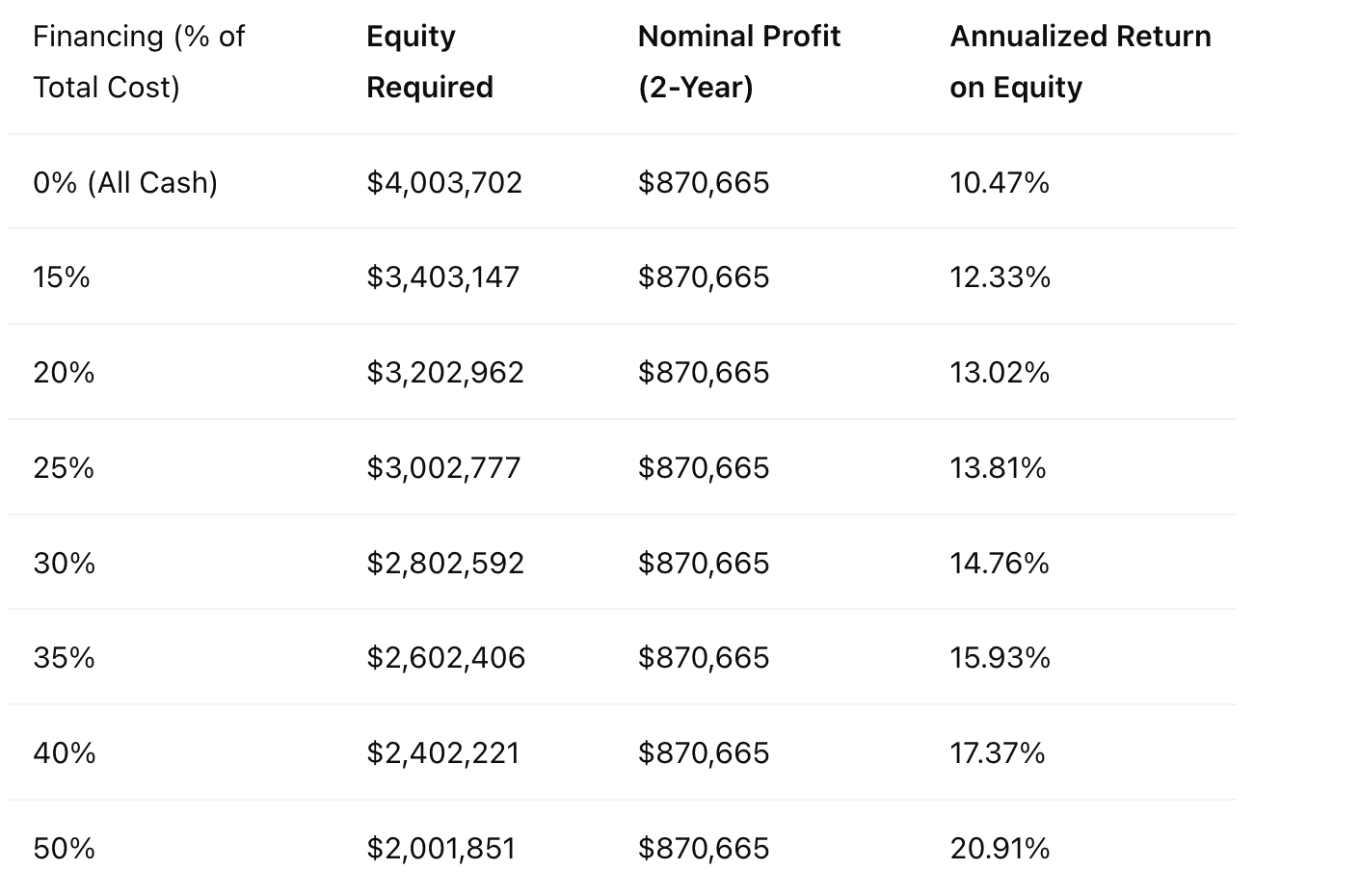
Notes: Two‑year horizon; simplified view (no draw schedule, points, or interest). Leverage amplifies the apparent ROE but doesn’t make the house worth more or the buyer pay more. It also amplifies risk if prices, timelines, or costs slip.
This 25% nominal return scenario is the cowboy’s comfort zone and the sweet spot for the hands-on investor who wants to maybe manage crews and be part of the process. This cowboy is certainly anyone that wants to keep the home and do better than just a retail purchase.
This return is well high enough for many to justify the risk but still within reach of realistic execution. The cowboy bets on speed, cost control, and optimism believing the skill of the builder and the quality of the design, timing, and relationships that can convert a good project into a great one.
The cowboy loves this table. The investor studies it carefully. The difference? The cowboy mistakes optical leverage gains for skill. The investor recognizes that debt multiplies both upside and risk. If the market wobbles, the cowboy’s double‑digit annualized return can turn into a negative equity position almost overnight. Still the cushion and rational decision making is required. Yes we have had investors sell more quickly at less than market prices when things were not working out. Most notably in Watercolor Phase V which was first thought to be a great idea that soon was eclipsed by Watersound At Camp Creek. As this phase came out of favor we had two investors exit and closer to breakeven that was hope a year or two earlier, and they lived to fight another day.
True professionals respect leverage, but they don’t worship it. But What If?
When the Cowboy Is His Own Sheriff
Now, let’s take the same scenario and adjust one key element that the cowboy is also his own sheriff. In this case, he’s not paying a general contractor or builder fee. That fee, which averaged roughly $295,000 in the prior example, now stays in his pocket. Why? Because he is a trusted friend and builder himself. Are you able to be your own contractor? If so we can help you understand that process.
That adjustment raises the nominal profit from $870,665 to $1,165,665. With the same total project cost of $4,003,702, the all‑cash return increases from 10.47% to 13.90% over two years, before even considering any leverage.
Here’s how that shift looks when we reapply the same financing ratios:
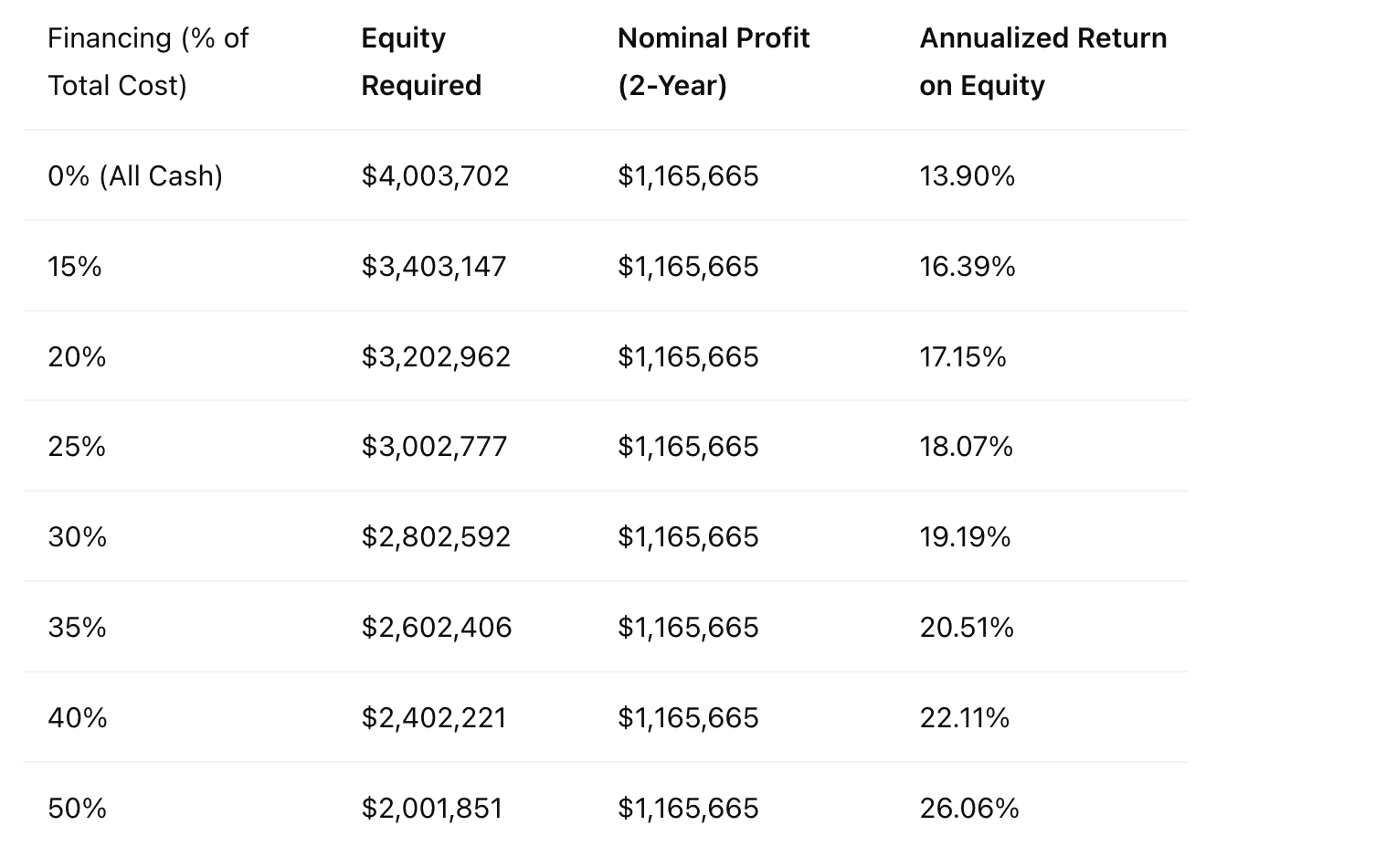
This is the builder-developer archetype the true cowboy who not only takes the risk but controls the execution. By removing the builder fee, he effectively captures both margins: the construction spread and the ownership return. The danger, of course, is that his time, overhead, and opportunity cost are now fully embedded in the deal. It’s higher reward, but also higher exposure if the project slows or costs overrun. This is a very good business model for at least two of our main builder clients. I do not mind saying it, but yes one of our primary builders is in the camp and another one too as well as me and Gayle who by relationship and business arrangement are able to supervise our own builds.
But The Takeaway
When sellers in Old Seagrove hold out for fantasy prices based on what their neighbor “heard” a home sold for or a lot is worth, they ignore what actually drives profitability. The market doesn’t care what someone thinks their lot is worth or the home that is clearly out of step with the obvious on coming future.
It cares what the end buyer will pay for a finished, furnished, turn-key home and whether there’s enough room in between for the next investor or builder to make a rational return.
We measure our work by that simple reality and the math doesn’t lie. We also measure our work by knowing our integrity is high even when the critics come, because in all of this 70% of the people buying the homes we work on with our teams together are not using those homes as rental properties. That is our real mission. Great homes and Great People to create the neighborhood that everyone thinks they want, but that we are building.