

Last time I wrote about values and joys — the rocks we protect and the rhythms we repeat.

This one goes a layer deeper. Because there is a second confusion hiding inside the first, and it costs people more money, more time, and more happiness than almost any other mistake I watch happen.
We confuse cost with value.
Say those two words to most people and watch what happens. Cost gets answered instantly. Cost is money. Cost is the expense. Cost is the number on the receipt, the line on the closing statement, the figure your brain grabs first because it is sitting right there, measurable and clean.
Value? Value takes a pause.
That pause is the whole article.
Two Hamburgers
Let me make this simple.
What is the value of a McDonald’s hamburger?
You know exactly what you’re getting. It costs a few dollars. It solves hunger. It is the same in Memphis and Miramar Beach and probably Mars when we get there. The cost is low. The value is... known. Predictable. Sufficient.
Now — what is the value of a hamburger at Pickles in Seaside?
The cost is very different. Several times different. And if you only looked at cost, the decision would be over before it started. A hamburger is a hamburger is a hamburger, right?
Wrong. And you already know it’s wrong.
Because the Pickles hamburger comes with the bike ride to get there. The salt air. The kids running on the lawn at the amphitheater. Sand still on your feet. The conversation at the picnic table that nobody is in a hurry to end. You are not buying a hamburger. You are buying an afternoon you will still remember in ten years.
What did the McDonald’s hamburger cost? Less.
What was it worth? Also less. Considerably less.
Cost is what you pay. Value is what you get. And the gap between those two numbers — positive or negative — is where every good and bad decision of your life actually lives.
Now Do the Beach Home
What is the cost of a beach home?
I can answer that one as an economist, and I have. Down payment. Carrying costs. Insurance. Maintenance. Opportunity cost on the capital. It is arithmetic, and the arithmetic is real. I will never tell you otherwise.
But now ask the other question. What is the value of a beach home?
Suddenly the spreadsheet goes quiet.
Because the value of a beach home is Thanksgiving with your whole family under one roof instead of three hotel rooms.
It is your grandkids learning to swim in the same Gulf you walk every morning. It is a place of refuge — and if you read the last article, you know that word is not decoration for me. It is the conversation you had on the porch that never would have happened in a restaurant. It is the version of you that exists at the beach and nowhere else.
None of that appears on the closing statement.
And here is the trap: because cost is measurable and value is not, people treat cost as real and value as fuzzy. They optimize the number they can see and ignore the number that actually matters. Then they realize it. Too late. Almost always too late.
I have never once heard someone at the end of their life say, “I’m so glad I saved that money instead of buying the place where my family would have gathered for twenty years.” Not once. I have heard the other sentence more times than I want to count.
The Part Where I Pick a Fight With My Own Industry
Now let me say something that will not make me popular at the next realtor convention. Most realtors could not care less about this distinction.
A client says “I want to spend less,” and the agent salutes. Lower cost, faster close, easy story to tell. Saving you money feels like service. It photographs like service.
But here is the question almost nobody in my industry asks: saving money at the expense of what?
Lower cost at the expense of bad value is not a win. It is a loss wearing a discount sticker. The house twenty minutes from the beach instead of three. The floor plan that means half the family stays home. The “deal” in the location nobody actually wanted. The agent who lets that happen — or worse, encourages it because it was easier — did not save the client anything. They cost the client the very thing the client was trying to buy - Value.
A professional’s job is not to find you the lowest cost. It is to challenge you, sometimes uncomfortably, on whether the cost you’re avoiding is buying you value or destroying it. That conversation is harder. It is also the entire job.
Why You Can’t Just Look Up the Answer
Here is where the behavioral economics comes in, and where this gets genuinely interesting.
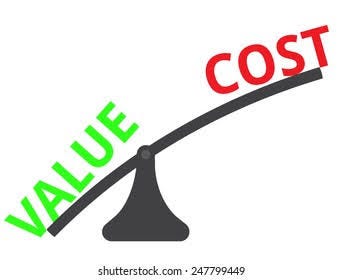
Cost is objective. Value is not. Value should weigh much more.
The Pickles hamburger is worth more to me than to the person who hates sand. The beach home is worth more to the family that gathers than to the family that scatters. Your value and my value for the identical asset, at the identical cost, can be wildly different — and we are both right.
This is why every economic model of “rational” decision-making eventually breaks. The trade-offs are not standard. They are personal. Prospect theory tells us we feel losses about twice as hard as gains, so the visible cost screams while the invisible value whispers. Mental accounting tells us we put the purchase price in one bucket and the family memories in another and never let the buckets talk to each other.
The math can’t save you here. There is no formula where you plug in “Thanksgiving under one roof” and get a number back. So what do you do?
You talk it out. Really talk it out.
Not “what can you afford” — that’s the cost conversation, and it takes ten minutes. The value conversation takes longer. What are you actually buying this for? Who is going to be in it? What does the tenth year look like, not the first? What would you regret more — paying too much, or watching someone else’s family on the porch you almost bought?
We can never completely measure value. That is true. But unmeasured is not the same as unknowable. Value reveals itself in conversation — between spouses, between generations, between a client and a professional willing to ask the harder question.
The Bottom Line
You are most likely in a cost vs. value conversation if the first chat was about a buyer brokerage agreement. Cost is the easy number. It is sitting right there on the page, and your brain will grab it every time.
Value is the real number. It hides in the years after the closing. Coffee and conversation is required here.
Make decisions on cost alone and you will win a hundred small games and lose the one that mattered. Make decisions on value — clear-eyed about cost, but anchored to value — and the receipt becomes what it always should have been.
A footnote. Not the story.